What Happens in the First 90 Days With a Digital Marketing Agency
You’ve signed the contract. The kickoff call went well. Now what?
For most businesses, the first three months are the hardest to judge. Results are rarely visible yet, and it’s easy to wonder whether the agency is doing anything at all. Many founders expect leads by week three, and when that doesn’t happen, they assume the agency is slow. Usually, though, the timeline was never explained.
This guide walks through what a well-run digital marketing engagement looks like in its first 90 days, what you should be doing alongside your agency, and what to measure at each checkpoint. It’s written for business owners in Nigeria who are hiring a digital marketing agency for the first time, or switching to a new one.
Quick Answer
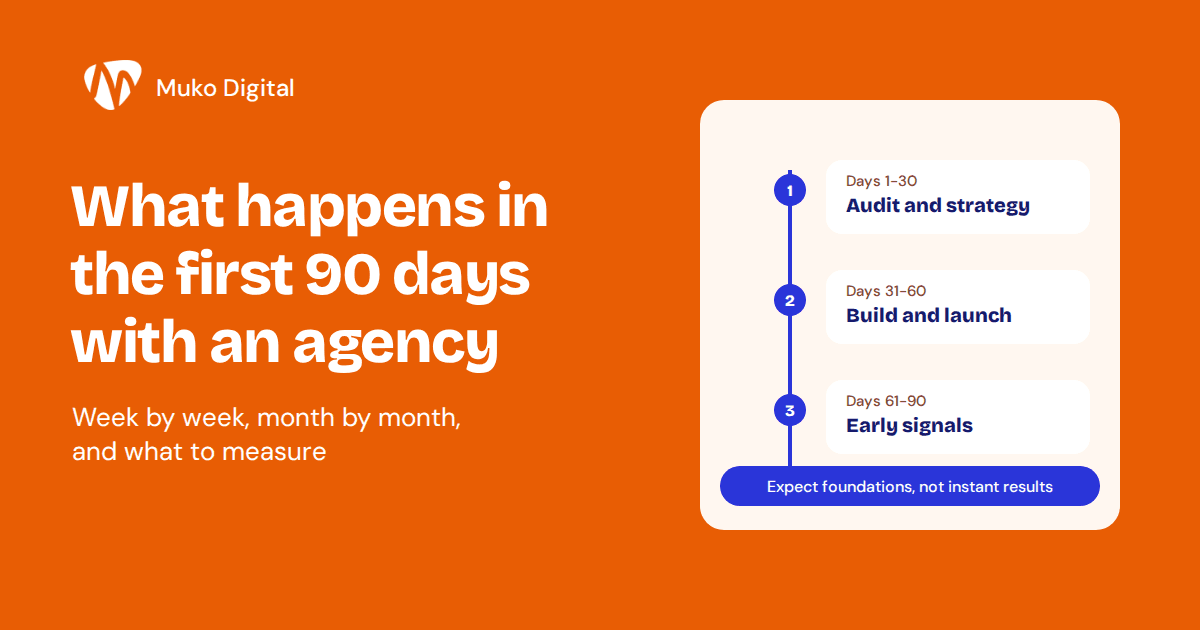
In the first 90 days, a good digital marketing agency focuses on foundations, not finished results. Days 1 to 30 cover access, audits and an approved plan. Days 31 to 60 bring campaigns, fixes and first reports. Days 61 to 90 show early trends in enquiries and sales, followed by a formal review and a plan for the next quarter. If you’re not seeing those milestones, raise it early.
Why the First 90 Days Matter
The first 90 days are when a client is still deciding whether the decision was right. Agency churn analysis reported in 2026 found this period carries the highest risk of the relationship ending, and that agencies running formal check-ins at 30, 60 and 90 days tend to keep clients longer. The same logic applies in reverse: a client who sees clear milestones is far more likely to stay patient through the slow months.
That’s why this period is worth planning for. A clear plan protects both sides, and it’s the best early test of whether the agency communicates well.
Phase 1: Days 1 to 30, Audit and Strategy
This phase is about understanding your business before running anything new.
What the agency should do:
- Set up access to your ad accounts, analytics, website and listings. Confirm that the accounts are in your name, with you as admin.
- Audit your current channels: website speed and structure, search visibility, social profiles, existing ads and tracking.
- Check your tracking. If calls, form submissions and WhatsApp enquiries aren’t being measured, fix that first.
- Agree on targets, the audience and the budget.
- Present a written strategy for your approval.
What you should do:
- Share your sales process, your best customers and the leads you’ve lost, along with your margins and realistic targets.
- Give access quickly. Delays here usually cost more time than any other factor.
- Name one decision-maker who can approve the plan quickly.
What you shouldn’t expect: a flood of leads. This phase is groundwork, not results.

Phase 2: Days 31 to 60, Build and Launch
This is when the strategy turns into action.
What the agency should do:
- Launch campaigns, content and technical fixes approved in phase one.
- Start regular reporting on leads, enquiries and traffic. Expect early numbers, which can be noisy.
- Make adjustments based on what the first data shows, such as pausing an underperforming ad or rewriting a weak page.
What you should do:
- Respond to approvals and feedback within a day or two.
- Keep a simple record of where enquiries come from, including phone calls, WhatsApp and walk-ins. Agencies can’t see offline sales.
What you shouldn’t expect: a finished search ranking. Some channels, especially SEO, take months to compound. One onboarding guide expects SEO to start taking off around month 12 if recommendations are implemented consistently.
Phase 3: Days 61 to 90, Early Signals and Review
By now you should have enough data to see patterns.
What the agency should do:
- Show trends in enquiries and sales, not just clicks and impressions.
- Run a formal 90-day review covering what worked, what didn’t, and why.
- Propose the next quarter’s plan, including budget and priorities.
What you should do:
- Compare the leads reported by the agency with your own sales records. If they don’t match, find out why.
- Decide whether the plan and the working relationship are on track.
What you should see: early signals, not a finished result. Channels like paid ads can show meaningful signals within 60 to 90 days, while SEO takes longer.
Three Checkpoints to Hold Your Agency To

Put these dates in your calendar on day one:
- Day 30: access is complete, the audit is shared, and the strategy is approved.
- Day 60: campaigns or fixes are running, and the first reports are in.
- Day 90: you have early signals, a formal review and a plan for the next quarter.
If any checkpoint is missed, ask for a written explanation and a new date. A reasonable delay with a clear reason is normal. Silence is not.
Red Flags in the First 90 Days
Watch for these early warning signs:
- Access to your accounts keeps being delayed, or accounts are created in the agency’s name.
- Reports focus on impressions and reach with no link to enquiries or sales.
- No named person runs your account, or you can’t reach them.
- The agency promises fast results with no audit or plan first.
- Changes are made without telling you.
- Meetings are repeatedly rescheduled, and no written updates arrive.
Any one of these may have an innocent explanation. Several together are a reason to have a direct conversation.
What Good Looks Like at Day 90
A healthy first 90 days usually ends with:
- Full access to every account you own, with documentation.
- Working tracking that connects campaigns to enquiries and sales.
- A written audit and strategy you approved, and a record of what changed.
- Early trends you can explain, even if they’re still small.
- A clear plan for the next quarter, with agreed targets.
If you have those five things, the relationship is on solid ground, even if the results are still building.
Setting Up Your Own Expectations
Your part matters as much as the agency’s. Before you start:
- Agree on the 90-day scope in writing.
- Decide who on your side will approve work and how quickly.
- Set up a simple way to log offline enquiries.
- Book the day-30, day-60 and day-90 review meetings in advance.
Agencies work best with clients who respond quickly and share honest information. The first 90 days are when that partnership is built.
Conclusion
The first 90 days with a digital marketing agency are about foundations: access, audits, a clear plan, working tracking and early signals. Results come later. If you know what each phase should deliver and you hold the agency to three checkpoints, you’ll know within a quarter whether the partnership is on track.
If you’d like to see what a structured first 90 days looks like with us, get in touch with the Muko Digital team, or explore our SEO service and web development service. For the selection side, read our guide to how to choose the best digital marketing agency.
Frequently Asked Questions
What should a digital marketing agency do in the first 30 days?
Set up access to your accounts, audit your current channels and tracking, agree on targets and budget, and present a written strategy for approval. Results aren’t expected yet.
When should I see results from a digital marketing agency?
It depends on the channel. Paid ads can show meaningful signals within 60 to 90 days, while SEO takes longer to compound. Expect early trends by day 90, not finished results.
Should my accounts be in my name or the agency’s?
In your name, with you as admin. You should keep ownership of ad accounts, analytics, listings and creative even if you change agencies.
What is a normal onboarding period for a marketing agency?
Many agencies run onboarding for roughly 30 to 45 days before campaigns go live and then move into regular reporting cycles.
What should I do if my agency misses a checkpoint?
Ask for a written explanation and a new date. A reasonable delay with a clear reason is normal. Repeated silence or missed meetings are warning signs.