How to Write a Digital Marketing Plan for a Small Business in Nigeria
Many small business owners know they should “do digital marketing”. Fewer can say what it’s for. They post on Instagram because others do, run an ad when a friend recommends it, and redesign the website when it looks dated. Activity goes up, but results don’t follow, because nothing ties the activity to a goal.
A digital marketing plan fixes that. It doesn’t need to be long or expensive. For most small businesses, a one-page plan written once a quarter is enough to decide where time and money go and to tell whether it’s working.
This guide shows you how to write one, step by step, with a template you can copy.
Quick Answer
To write a digital marketing plan, do these six things in order: Set one clear goal, define your customer, check what you already have, choose two or three channels, decide how much time and money you can commit, and set a monthly review. Write it on one page, and review it every three months.

Step 1: Set One Clear Goal
Start with the result you want, not the channel. “Get more customers” is too vague. “Get 20 qualified enquiries a month from my service area by the end of the quarter” is specific enough to plan around.
Choose one main goal for the next three months. You can have supporting goals, but one clear target stops you from spreading effort too thin.
Good goals include:
- Several enquiries or bookings per month
- Sales from a specific product or service
- Calls, WhatsApp messages or form submissions from a defined area
Avoid goals that describe activity, such as “post three times a week”. Activity is how you reach the goal, not the goal itself.
Step 2: Define Your Customer
Write down who buys from you, in plain language. Include:
- Who they are: age range, location, and whether they buy for themselves or for a business
- What they’re trying to solve: the problem that brings them to you
- How they search and decide: Google, WhatsApp, Instagram, referrals or walk-ins
- What stops them buying: price, trust, delivery time or lack of information
If you can’t describe your customer clearly, write down your five most recent customers and what they had in common. Ask them directly how they found you. You’ll often discover a channel you didn’t expect.
Step 3: Check What You Already Have
Before you add anything, see what’s working. Make a short list:
- Your Google Business Profile: Is it claimed, complete and up to date? You can claim one through Google Business Profile.
- Your website: Does it load quickly on a phone? Does it explain what you do on the first screen? Does it have a clear way to contact you?
- Your social profiles: Are the name, description and contact details the same everywhere?
- Your reviews: How many do you have, and how recently were they written?
- Your tracking: Can you tell which enquiries came from which source?
- Your enquiry handling: How quickly do you respond to WhatsApp, calls and forms?
Our guide to digital marketing for small businesses in Uyo and Akwa Ibom explains the foundations to fix first. If your site or tracking is weak, put those at the top of the plan. The web development service covers the website side if it needs rebuilding.
Step 4: Choose Two or Three Channels
A channel is a route customers use to find you. Pick the ones your customers already use, and resist the urge to cover everything.
Common choices for Nigerian small businesses:
- Google search and Google Business Profile: for customers searching for a service near them
- WhatsApp: for direct enquiries and orders
- Facebook or Instagram: for recognition, proof of work and offers. Our social media marketing service covers this in more depth.
- Website and SEO: for long-term visibility in search and AI answers. Our SEO service explains the approach.
- Paid ads: for faster, targeted reach once your offer and tracking are ready. Our PPC advertising service covers the setup.
For each channel you choose, write one sentence on why it fits your customer. If you can’t, drop it.
Step 5: Decide What You Can Commit
A plan you can’t sustain fails quickly. Be honest about:
- Time: how many hours a week you or your team can spend on marketing
- Money: what you can spend each month, including tools, ad budgets and any help you hire
- Skills: what you can do in-house and what you’d need to outsource
Set a monthly budget you can keep for three months. If you’d like to compare with our own current rates, see our pricing page. Ad budgets are easier to scale up later than to pull back once customers expect a service. To see how agencies structure their fees, look at the price listing in our digital marketing agency cost guide. Its figures are US SEO benchmarks converted to naira, so treat them as a guide to structure, not as Nigerian prices. Use them to set a rough budget range before you ask for quotes.
If you’re weighing outside help, our guide on how to choose the best digital marketing agency sets out what to look for. Our digital marketing agency cost guide explains how agencies charge and what to compare.
Step 6: Plan the First 90 Days
Break the quarter into actions. A simple version looks like this:

| Month | Focus | Example actions |
| Month 1 | Foundations | Complete your Google Business Profile, fix listing details, set up tracking, record your baseline numbers |
| Month 2 | Launch | Start your chosen channels, post on a schedule, begin asking customers for reviews |
| Month 3 | Test and review | Compare results to your goal, stop what isn’t working, double down on what is |
Each action should have an owner and a deadline. If nobody owns it, it won’t happen.
For a fuller look at what each phase should deliver with an outside provider, read what happens in the first 90 days with a digital marketing agency.
Step 7: Set Measures and a Review Routine
Choose three to five numbers you’ll check every month. Keep them tied to your goal, for example:
- Enquiries by source (WhatsApp, calls, form, walk-in)
- Google Business Profile calls and direction requests
- Website visits from your target area
- Number of reviews received and average rating
- Sales from enquiries

Then set a routine: a 30-minute review once a month and a longer look once a quarter. In each review, ask three questions: what worked, what didn’t, and what will we change next month?
If your numbers are weak, the cause is often in how enquiries are tracked. Our post on running your own AI visibility audit gives a method for checking whether customers can find you in AI answers, which is worth adding once the basics are in place.
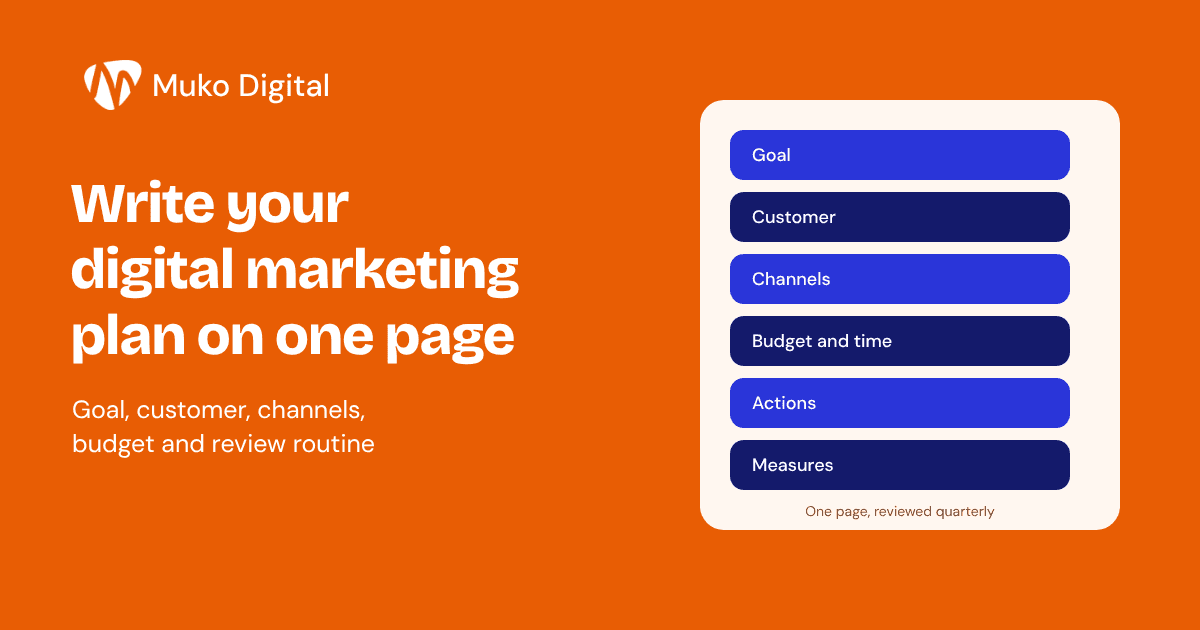
Your One-Page Plan Template
Copy this into a document and fill it in. It should fit on one page.
Goal (next 3 months): [e.g. 20 qualified enquiries a month from my service area]
Customer: [who they are, what they need, how they decide]
Current position: [what is working, what is broken, what is missing]
Channels (choose 2 or 3): [channel, and one sentence on why it fits]
Monthly budget and time: [amount and hours per week]
Actions for months 1, 2 and 3: [action, owner, deadline]
Measures (check monthly): [three to five numbers, and where each comes from]
Review dates: [monthly and quarterly]
Common Mistakes to Avoid
- Writing a plan with no goal, so you can’t tell whether it worked
- Choosing channels because competitors use them
- Trying to cover every platform at once
- Forgetting to track which enquiries come from where
- Spending on ads before your website and listings are ready
- Writing the plan once and never reviewing it
- Measuring likes and reach instead of enquiries and sales
What a Good Plan Looks Like at the End of the Quarter
A working plan usually leaves you with:
- A clear view of which channels brought enquiries
- A short list of what to stop, keep and try next
- Baseline numbers, so the next quarter is easier to judge
- A review date already in the calendar
If you can answer those four points, the plan has done its job, even if the results weren’t what you hoped.
Conclusion
A digital marketing strategy for a small business doesn’t need to be complicated. Set one goal, know your customer, check what you already have, choose a few channels you can sustain, and review the numbers regularly. Write it on one page and revisit it every quarter.
If you’d like help writing your plan or carrying it out, get in touch with the Muko Digital team. You can also explore our SEO, web development, social media marketing, content marketing, branding and design and PPC advertising services.
Frequently Asked Questions
What is a digital marketing strategy for a small business?
It’s a short plan that sets one goal, identifies your customer, names the channels you’ll use, and defines how you’ll measure results over a set period.
How long should a digital marketing plan be?
One page is enough for most small businesses. Longer plans can help larger teams, but they’re often ignored.
How often should I update my digital marketing plan?
Review it monthly and rewrite it quarterly. Update it sooner if your goal, budget or market changes.
Do I need a digital marketing agency to write a plan?
No. You can write one yourself using the template above. An outside provider can help if you lack time or specialist skills.
What if I don’t know which channels to choose?
Ask your last few customers how they found you. Their answers usually point to the channels worth testing first.