How to Choose the Best Digital Marketing Agency for Your Business
Most businesses that choose the wrong agency don’t find out in the first week. They find out three months later, when the reports are full of impressions, the results are vague, and nobody can say what the monthly fee actually bought.
The best digital marketing agency isn’t the one with the loudest pitch or the lowest quote. It’s the one that fits your goals, shows real proof, explains how it measures success, and lets you see and own what it builds for you. This guide gives you a practical way to find it: a 7-point scorecard, the questions to ask, the red flags to avoid, and Nigeria-specific checks to run before you sign.
A disclosure: Muko Digital is a digital marketing agency in Uyo, so we have an interest here. We’ve written this to be useful whichever agency you choose, and you should run the same checks on us.
Quick Answer
To choose the best digital marketing agency, define your goal and budget first, shortlist three to five agencies, and score each one on the same seven points: measurement, relevant proof, a named team, transparent pricing, account and data ownership, a fair contract, and communication. Speak to references, verify the company’s registration, and reject any agency that guarantees rankings or won’t give you admin access to your own accounts.
Step 1: Know What You’re Buying
Agencies sell three different things, and it helps to know which one you need:
- Strategy: a plan, budget and targets that your own team will run.
- Execution: someone to build and run campaigns on one or more channels.
- Ownership: an outside team that runs your whole growth function and reports to your leadership.
Before you contact anyone, write down three things: the outcome you want, your budget, and who on your side will make decisions. Every agency conversation goes better when those are on the table.
Be specific about the outcome. “More customers” isn’t a goal. “Twenty qualified enquiries a month from Uyo and Port Harcourt” is. Define success in your own unit, such as leads, sales or bookings, so you can judge the agency against it later.
Step 2: Score Every Agency the Same Way
Use the same criteria for every candidate. Otherwise, the best presenter wins, not the best fit.

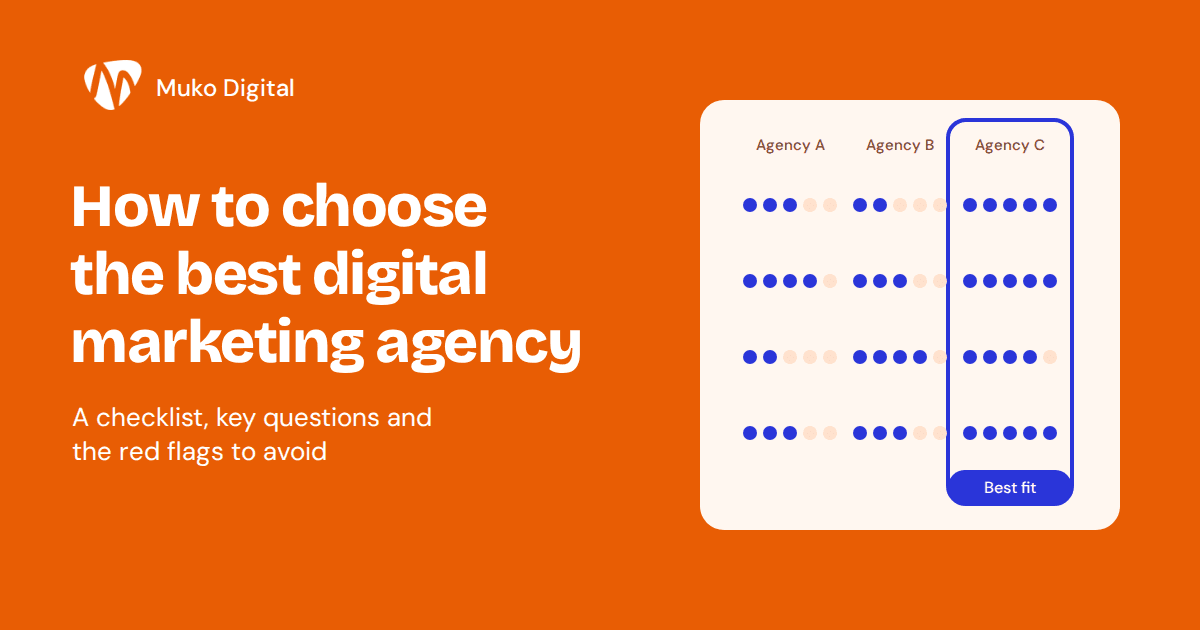
Score each agency from 1 to 5 on these seven points:
- Clear goals and measurement. The agency should judge success by leads, sales or revenue, not reach.
- Relevant proof. Case studies should show the starting point, the agency’s role and measurable results from comparable work.
- A named team. You should know who runs your account day to day.
- Transparent pricing. The scope should be itemised so you can compare quotes fairly.
- Ownership and access. Ad accounts, data and creative should be in your name.
- A fair contract and exit. Be wary of long lock-ins with no off-ramp.
- Fit and communication. A good agency asks about your business before proposing a solution.
One finding is worth keeping in mind: most bad agency relationships fail on transparency and ownership, not on capability. That’s why points 5 and 6 carry as much weight as points 1 and 2.
Step 3: Ask the Right Questions
Use these in your first and second calls.
| Topic | Ask | A good answer sounds like |
| Goals | “How will you measure success for us?” | Leads, sales or revenue, tied to your goal, not reach or likes |
| Strategy | “What would you want to know about my business first?” | Questions about your customers, margins, sales process and competitors |
| Proof | “Show me a case study in a business like mine.” | A named example with a starting point, the agency’s role and results |
| Team | “Who will run my account, and what is their workload?” | A named person, with clear time allocated |
| Reporting | “What does your monthly report include?” | A real, anonymised sample, focused on outcomes |
| Tracking | “How will you set up tracking on day one?” | Working conversion tracking before any spend |
| Ownership | “Will every account be in my name, with me as admin?” | Yes, with full access to ad accounts, analytics and listings |
| Exit | “If we part ways, what transfers to me and when?” | A clear written handover of accounts, data and creative |
| Pricing | “What exactly does the fee include?” | An itemised scope, and how changes are handled |
| AI search | “How do you approach visibility in AI answers?” | A concrete method, not buzzwords |
The most important questions concern who will manage your account, how results will be measured, what the fee includes, and who owns your accounts and data. Also ask how the team handles campaigns that underperform.
Step 4: Spot the Red Flags

Walk away, or at least push back hard, when you see these:
- Guarantees. Legitimate agencies don’t guarantee specific rankings, traffic or revenue.
- Ad accounts in the agency’s name. You should own them.
- No questions about your business. A good agency listens first.
- Reports built on reach and impressions with no link to leads or sales.
- A 12-month lock-in with no exit, or a vague “we’ll build a strategy in month one".
- No named project lead, or account managers who can’t speak to the work.
- Reluctance to share references or case studies.
Also look at the agency’s own website. It’s their main marketing tool, so if it’s slow, poorly designed or full of errors, that’s a bad sign.
Step 5: Understand How Agencies Charge

Agencies commonly use four models:
| Model | How it works | Best for | Watch out for |
| Monthly retainer | A fixed fee for a defined scope | Ongoing SEO, content and social media | Vague scope that lets work drift |
| Project fee | A set price for a deliverable | Websites, brand identity | Unclear revisions and timelines |
| Performance-based | A base fee plus incentives tied to results | Campaigns with clear, trackable metrics | Disputes over how results are counted |
| Hourly | Pay for time used | Audits, consulting, short fixes | Open-ended bills with no cap |
One vendor survey reports that retainers are the most common structure, used by roughly 78% of agencies. Treat that figure as a vendor claim, but it matches what most buyers encounter.
A note on price comparisons. We searched for Nigerian agency pricing and found no reliable naira benchmarks. The dollar ranges that appear online, which run from hundreds to tens of thousands per month, are US-based and shouldn’t be applied to Nigeria. So compare quotes by what each includes, not just the total, and ask:
- Is the quote in naira, and what happens if exchange rates move?
- Is ad spend included, or billed separately?
- Which tools, software and subscriptions are covered?
- How are extra requests priced?
Step 6: Check the Contract Before You Sign
Most problems hide here. Look for:
- Account ownership in writing. Every account created in your name, with you as admin.
- Handover terms. What transfers to you if you leave, and within how many days.
- Creative ownership. Who owns the content, designs and assets produced for you.
- Notice period. One guide calls thirty days the honest standard, since long notice periods, cancellation fees and auto-renewals mostly make leaving expensive.
- Reporting schedule and meetings, agreed upfront.
Set realistic expectations on timing. One guide suggests paid ads should show meaningful signal within 60 to 90 days, while SEO compounds over months. Another puts a realistic ROI timeline at three to six months. Any agency that promises overnight results should make you cautious.
Step 7: Verify the Agency in Nigeria
These checks take less than an hour and filter out most bad actors.
Verify the company’s registration. The Corporate Affairs Commission offers a free public search at search.cac.gov.ng. Results show the company’s name, RC number, address and registration date. Enter the name exactly as it appears on the proposal or invoice. One caution: being registered doesn’t prove a business is legitimate or compliant, so treat it as a first filter, not a final answer.
Speak to references. Ask to speak to one or two current or former clients. Good questions include how responsive the agency is, whether results matched what was promised, and whether anything surprised them.
Read third-party reviews. Check independent platforms such as Clutch, The Manifest and Google, not only testimonials on the agency’s own site. For example, Muko Digital appears on The Manifest’s list of top influencer marketing agencies in Nigeria, which we wrote about in our ranking announcement.
Meet the actual team. Be cautious of agencies that claim huge teams for small accounts, or that outsource most of the work without saying so.
Local Agency or Lagos and Abuja? How to Decide
There’s no single right answer, but here’s how the trade-offs generally look. This is our reasoning, not data:
| Local agency (for example, in Uyo) | Larger-city or national agency | |
| Market knowledge | Often stronger for local audiences and language | Strong on national campaigns |
| Access | Easier to meet in person | Usually remote |
| Bench depth | Maybe smaller | Often larger specialist teams |
| Fit for small budgets | Often better | Can be priced for larger clients |
In our Nigerian Start-up Visibility Index, we found online agency visibility is concentrated in a few hubs, so don’t assume a well-known agency is the best match for you. Judge each one against your scorecard.
The New Question: Can They Help You Show Up in AI Answers?
Search is changing. Customers increasingly ask ChatGPT, Gemini and Perplexity who to hire, and those tools often recommend different brands. A good agency in 2026 should have a view on this. Ask how they would improve your visibility in AI answers, and look for answers that include:
- Consistent business facts across your website and profiles
- Third-party mentions, directories and reviews
- Answer-first content structured for questions customers ask
- A way to test and track results
Our guides explain these in depth: why ChatGPT, Gemini and Perplexity recommend different brands, getting listed where AI tools look, and social proof for the AI era. Be sceptical of any agency that promises guaranteed AI mentions. Nobody controls what an AI assistant says.
A 4-Week Selection Plan
| Week | Focus | What to do |
| 1 | Define | Write your goal, budget and decision-maker. List the channels you need |
| 2 | Shortlist | Pick three to five agencies. Check their sites, case studies, reviews and CAC registration |
| 3 | Calls and proposals | Ask the same questions of each. Request proposals with itemised scope |
| 4 | Decide | Call references, score each agency out of 35, review the contract, and agree a clear 90-day scope |
How to Evaluate Muko Digital
Since you should use this checklist on us too, here’s what you can verify:
- Services: SEO, web development, social media marketing, content marketing, branding and design and PPC advertising.
- Named case studies: ROHAI digital transformation and Siahjo corporate website, with more on our projects page.
- Third-party listing: named #16 on The Manifest’s Top 80 Influencer Marketing Agencies in Nigeria for October 2026.
- Location: based in Uyo, Akwa Ibom State, serving businesses across Nigeria.
- Self-reported figures on our homepage: 10+ projects completed, 98% client satisfaction and a team of 10+. These are our own numbers, so ask to speak to clients.
Ask us the questions in this guide, check our registration on the CAC portal, and compare us against any other agency on your shortlist.
Common Mistakes When Hiring an Agency
- Choosing on price alone.
- Skipping references.
- Signing before accounts, tracking and reporting are agreed.
- Letting the agency create ad accounts in its own name.
- Judging results by likes and impressions.
- Expecting results in the first few weeks.
- Never reviewing the work after month one.
Conclusion
The best digital marketing agency for your business is the one that scores best against your goals, not the one with the best pitch. Define what you want, score every candidate the same way, check the contract and ownership terms, verify the company, and speak to its clients. Do that, and you’ll avoid most of the expensive mistakes.
If you’d like to talk through your goals, get in touch with the Muko Digital team, email contact@mukodigital.com, or see our work first.
Frequently Asked Questions
How do I choose the best digital marketing agency?
Define your goal and budget, shortlist three to five agencies, and score each on measurement, proof, team, pricing, ownership, contract terms and communication. Check references and the company’s registration before signing.
What questions should I ask a digital marketing agency?
Ask how they will measure success, who will run your account, what the fee includes, who owns the accounts and data, what their reports look like, and what happens if you leave.
What are the biggest red flags when hiring an agency?
Guaranteed rankings, ad accounts in the agency’s name, no named account lead, reports based only on reach and impressions, long lock-ins with no exit, and reluctance to share references.
How much does a digital marketing agency cost in Nigeria?
We couldn’t find reliable Nigerian pricing data, and the ranges published online are in US dollars. Ask each agency for an itemised quote, confirm the currency, and compare what’s included.
How long does it take to see results?
It depends on the channel. One guide suggests paid ads show meaningful signal in 60 to 90 days, while SEO compounds over months. Be wary of promises of instant results.
Is a local agency better than one in Lagos or Abuja?
Not necessarily. Local agencies may know your market and be easier to meet, while larger-city agencies may have deeper teams. Judge each one on your scorecard.
How do I check that an agency is a registered company in Nigeria?
Use the Corporate Affairs Commission’s free public search at search.cac.gov.ng, entering the name exactly as it appears on the proposal. Registration is a first check, not proof of quality.
Should my agency help with AI search visibility?
It’s worth asking. Look for a concrete method covering consistent facts, third-party mentions, answer-first content and testing, and avoid anyone who guarantees AI mentions.