How Nigerian Startups Get Listed Where AI Tools Look: Directories, Rankings and Media
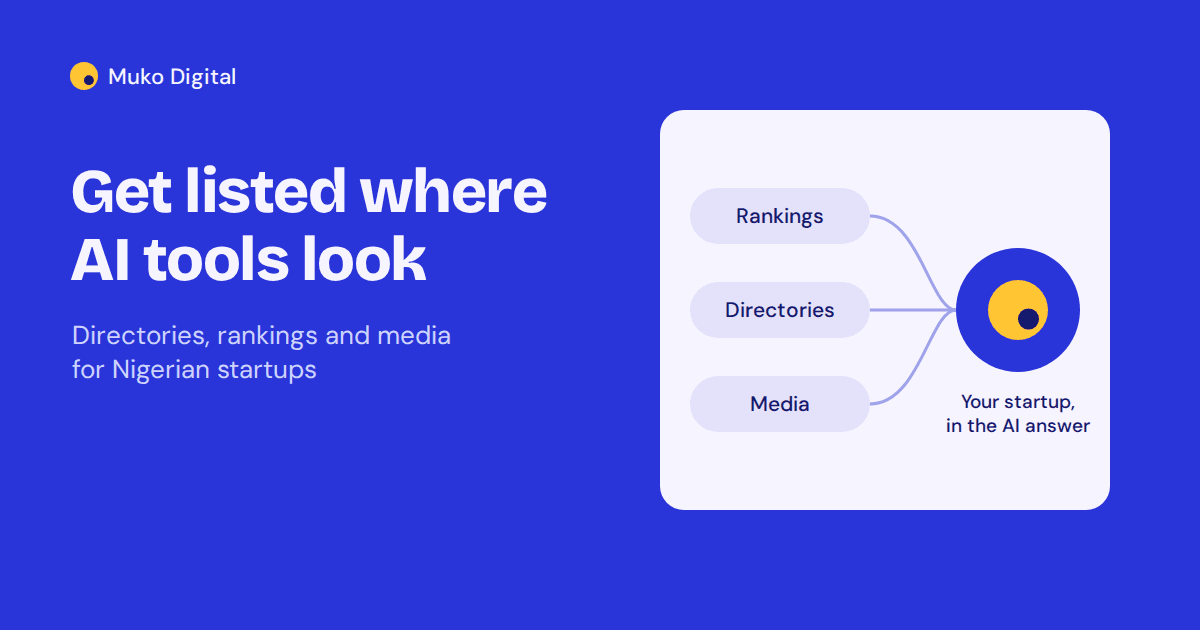
Ask ChatGPT, Gemini or Perplexity which Nigerian startups to watch, and you get a handful of names. Those names aren’t random. They’re the companies that appear repeatedly in rankings, directories, news coverage, and review sites, the places AI tools read before they answer.
If your startup isn’t in those places, it’s much harder for an AI tool to recommend you, however good your product is. This guide shows you where to get listed, how each place works, and how to pitch it, step by step. It builds on step 5 of our guide to getting your business mentioned by ChatGPT and Google AI Overviews.
Quick Answer
To get Nigerian startup mentions that AI tools can find, work in four layers. First, set up complete profiles you control (Crunchbase, LinkedIn, Google Business Profile). Second, get listed in directories and rankings like StartupBlink, Seedtable and the Nigeria Startup Act portal. Third, earn coverage in Nigerian tech media such as TechCabal and Techpoint Africa. Fourth, collect reviews and get included in “best of” roundups. Start with the free, easy layers, and don’t pay for placements hoping for AI mentions.
Why Third-Party Mentions Matter
AI tools lean heavily on sources other than your own website. Muck Rack’s May 2026 study of more than 25 million links cited by ChatGPT, Claude and Gemini found earned media accounted for 84% of citations, journalism for 27%, and paid and advertorial content for just 0.3%.

Read those numbers with care:
- “Earned media” is broad. The 84% includes academic research, government sources, encyclopedic sites and other third-party content, not only news articles.
- Journalism’s share has moved. Muck Rack’s October 2026 report found journalism’s share fell from about 27% in May to 22%, while the broader earned category stayed near 84% and paid content held at 0.3%.
- Press releases barely register. They made up 1.1% of citations in the May edition.
- It’s a vendor study. Muck Rack sells media monitoring and AI visibility services, and the prompts are largely US-based. We found no Nigeria-specific equivalent.
The practical point still holds. When several independent sites describe your business in a consistent way, a system has more reason to treat that description as reliable, while a claim that appears only on your own website is easier to overlook.
For “best X in Y” style questions, one analysis found AI tends to pull from editorial listicles, review sites and comparison content, and that different platforms often cite different sources. Another claim, from a vendor, is that only 12% of cited sources match across ChatGPT, Perplexity and Google AI, which means one listing is rarely enough.
The Four Layers of Third-Party Proof

Work from the bottom up. Each layer makes the next one easier to win, because journalists, list authors and AI tools all check whether you exist elsewhere before they mention you.
Layer 1: Profiles You Control
These take an afternoon and give everything else a foundation.
- Crunchbase: Any registered, socially authenticated user can add a profile page, and listing a company is free. Complete the description, founding date, location and founders.
- LinkedIn company page: Use the same name and one-line description as everywhere else.
- Google Business Profile: Worth setting up if customers visit or call you.
- One facts page on your website: Founding year, founders, location, product, and key numbers, dated and kept current. We saw in our Nigerian Start-up Visibility Index how conflicting numbers across sources make life harder for any summary, human or AI.
Layer 2: Directories and Rankings
| Platform | What it is | How to get listed | Notes |
| StartupBlink | Global startup ecosystem map and ranking | Use its “Add startup” page to submit your startup | Free to submit. Keep your profile accurate |
| Crunchbase | Company database used by investors and researchers | Register, authenticate with Google or LinkedIn, then create a profile | Free. Verify funding data and add founders |
| Seedtable | Rankings of funded startups | No public submission form found | Lists funded companies only. Its score blends total funding, how recently a company raised, stage and growth signals |
| Nigeria Startup Portal and Startup Label | Government registry under the Nigeria Startup Act 2022 | Apply on the Startup Support and Engagement Portal at startup.gov.ng | Eligibility rules apply. See below |
| Clutch | B2B services review platform | Create an account and complete a profile with case studies, reviews and services | Best for agencies and service companies |
| G2 and Capterra | Software review platforms | Create a vendor profile and collect verified reviews | Best for software products |
Seedtable in practice. Seedtable tracks funded companies, for example 44 funded technology startups in Nigeria. We found no way to apply directly, so for Seedtable the lever is a public, accurate record of your funding round. Make sure announcements name the amount, stage, lead investor and date, and that the round also appears on Crunchbase. If you’re unfunded, spend your time on the other layers.
The Nigeria Startup Act label. The Act tasks NITDA with issuing startup labels and maintaining a directory of startups, incubators and accelerators. To qualify, a startup generally must be a registered limited liability company in existence for less than 10 years, with objects focused on digital products, services or processes, and with at least 33% of shares held by a Nigerian founder or co-founder. A label is valid for 10 years. NITDA reported 12,948 startups registered on the portal when labelling began.
Two cautions. First, a 2026 report said that four years after the Act’s signing, it remained at a pre-implementation stage, with several incentives still elusive. Second, we couldn’t confirm that the directory is publicly searchable. Check the portal before treating it as a visibility channel. Even so, an official label is an independent, verifiable credential.
How to maintain a listing: Use identical wording for your name and description everywhere, update funding and team details when they change, and add links to news coverage as you earn it.
Layer 3: Nigerian Tech Media
Editorial coverage is the layer that most often leads to repeated mentions. Each outlet has its own process, and ignoring it is the fastest way to get rejected.
| Outlet | Route | What they want | What to avoid |
| TechCabal (startup features) | Pitch form, and a “Startups on Our Radar” nomination form | A clear problem, how your approach differs, what makes the product stand out, and who your competitors are | Companies replicating existing models without innovation. A pitch with no angle reads like an ad |
| TechCabal (guest articles) | Submission form only, not email | A coherent argument about Africa’s tech and business ecosystem, with sources and a bio explaining your expertise | Anything that reads like a press release or product white paper |
| Techpoint Africa (news and startups) | “Submit a tip” form | Notable innovations, startups and developments | Treating the tip form as an ad channel |
| Techpoint Africa (guest articles) | Email to the guest submissions address with the subject line “Guest Contributor” | Original contributions with proper attribution for data and images | Press releases, startup or personality features, and promotional content are not accepted as guest posts |
| Tech in Africa | Email pitch | A short description of your company and a 300-700 word article | Content already published elsewhere. Confirm whether a feature is editorial or paid |
TechCabal’s own advice on startup pitches is blunt: give an angle, include images and links to media that illustrate the story, and don’t expect coverage for news everybody already has. A pitch with no picture, they note, usually means no feature.
What counts as news. Journalists want something new. Strong angles include a funding round, a licence or regulatory approval, a launch with measurable traction, original data from your platform, a major partnership or expansion, or an expert opinion on a live industry issue.

How to Pitch: A Template You Can Adapt
Keep it short, factual and easy to verify. Replace the brackets with your details.
Subject: [One-line news hook, e.g. “Lagos logistics startup hits 10,000 deliveries a month”]
Body:
- The news in one sentence. What happened, to whom, and when.
- Three supporting facts. Numbers, dates and names a reporter can check.
- Why it matters to their readers. The problem, who is affected, and what’s different about your approach.
- Proof and assets. A link to your facts page, a founder photo, a logo, and any data or demo.
- The ask and your contact. Offer an interview with a named founder and a phone number.
Rules that raise your odds:
- Pitch the right person. Read the outlet’s recent coverage and match your story to a section.
- Follow the submission route. If an outlet says “form only,” don’t email.
- One pitch at a time. Don’t send the same exclusive to every outlet simultaneously.
- Don’t chase aggressively. If you hear nothing, follow up once after a reasonable gap.
- Link back. When you’re covered, add the article to your facts page and Crunchbase profile. It builds the trail AI tools follow.
A note on paid placements. Some outlets sell sponsored content or “brand” packages. These are a legitimate promotion, but in Muck Rack’s data paid and advertorial content made up just 0.3% of citations. Treat paid placements as advertising, not as a way to earn AI mentions, and make sure any sponsored piece is clearly labelled.
Layer 4: Reviews, Roundups and Community
Reviews. For services and software, collect reviews on the platforms your buyers use: Clutch for agencies and B2B services, G2 or Capterra for software, and Google and Facebook for consumer-facing businesses. We cover the research on how reviews relate to AI citations in our post on social proof for the AI era. As an example of an independent listing, Muko Digital appears on The Manifest’s list of top influencer marketing agencies in Nigeria.
Roundups and “best of” lists. Listicles are a major route into AI answers for category questions. The approach:
- Run your category prompts in ChatGPT, Gemini and Perplexity. Our AI visibility audit guide has 20 to start with.
- Note which listicles, directories and review sites get cited.
- Focus on the five to ten editorial sources that AI actually retrieves for your category.
- Contact the authors with a short, factual note: who you are, what you do, and why you fit the list. Offer data or a demo, not a request for a favour.
Be cautious with “pay to be listed” roundups. If a list is clearly advertising, it’s unlikely to carry the credibility you want.

Your 90-Day Plan
| Weeks | Focus | Actions |
| 1 to 2 | Foundations | Create your facts page. Set up Crunchbase and LinkedIn. Make every description identical |
| 3 to 4 | Directories | Submit to StartupBlink. Check your eligibility for the Startup Label. Claim Clutch or G2 profiles if relevant |
| 5 to 8 | Media | Choose two outlets. Prepare a pitch with a clear news hook and assets. Submit through each outlet’s official route |
| 9 to 12 | Reviews and roundups | Ask clients for reviews. Identify the listicles AI cites for your category and contact the authors. Re-run your audit prompts |
Common Mistakes to Avoid
- Skipping the facts page, so different sites show different numbers.
- Sending press-release-style pitches to outlets that reject them.
- Emailing outlets that only accept form submissions.
- Paying for placements and expecting AI mentions.
- Listing on low-quality directories that exist only to sell links.
- Letting profiles go stale after a funding round or rebrand.
A Realistic Expectation
None of this guarantees an AI mention. Results vary by platform, prompt and day, the research is largely US-based, and Nigerian startups are thin in the global AI indexes we checked. What you can do is give AI tools more independent, consistent evidence that your startup exists and is credible. That same evidence helps with Google, journalists and investors too.
Conclusion
Getting listed where AI tools look is slow, unglamorous work: accurate profiles, the right directories, well-pitched coverage and genuine reviews. Do it in order, keep your facts consistent, and measure what changes.
If you’d like help building your listings, pitching media or auditing your AI visibility, get in touch with the Muko Digital team, or explore our SEO service.
Frequently Asked Questions
What are the best Nigerian startup directories?
Start with Crunchbase, StartupBlink and the Nigeria Startup Portal, then add Clutch or G2 depending on whether you sell services or software. Seedtable lists funded startups, so it depends on your funding record.
Can I submit my startup to Seedtable?
We found no public submission form. Seedtable ranks funded companies using total funding, how recently they raised, stage and growth signals, so a clear public funding announcement is the practical route.
Do I need the Nigeria Startup Label to get AI mentions?
No. It’s a government credential with eligibility rules, and it isn’t a requirement for being cited. It may add independent credibility, but check whether the public directory is live.
How do I get featured on TechCabal or Techpoint Africa?
Use their official routes: TechCabal’s startup pitch or “Startups on Our Radar” form, and Techpoint’s tip form. Lead with a clear news angle, supporting facts and images. Press-release-style pitches are rejected.
Do paid features or press releases help AI visibility?
The evidence suggests very little. In Muck Rack’s May 2026 data, paid and advertorial content was 0.3% of citations and press releases were 1.1%. Earned coverage matters far more.
How long does it take to see results?
Profiles and directory listings can go live within days, while media coverage and reviews build over months. Re-run your audit prompts monthly to see what changes.