Why ChatGPT, Gemini and Perplexity Recommend Different Brands
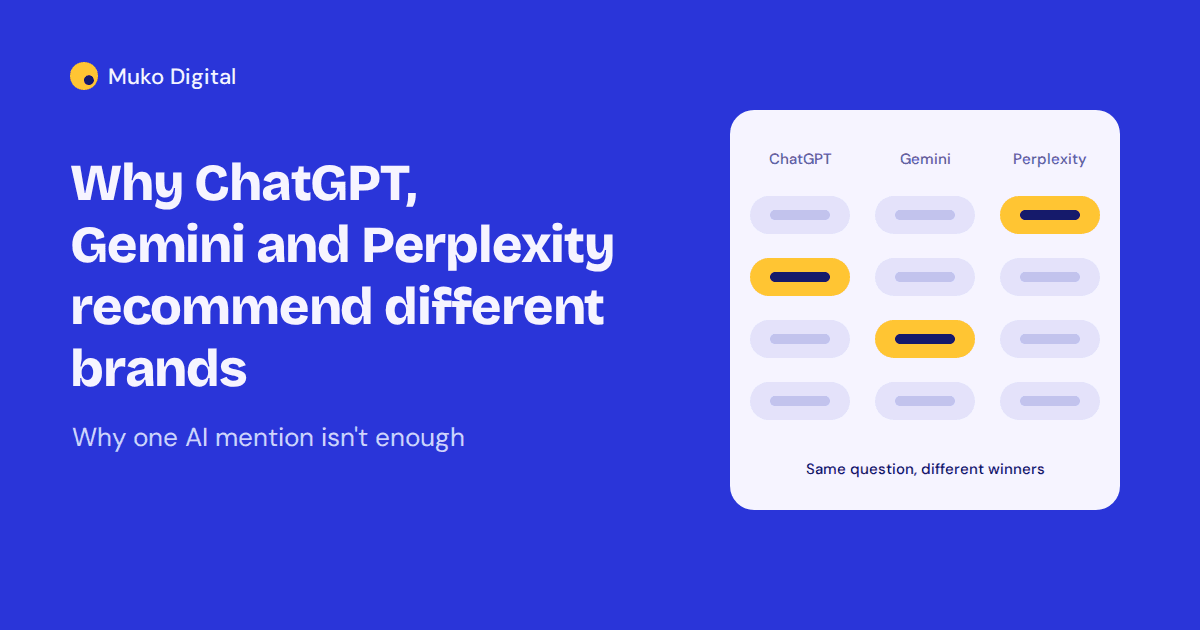
Ask three AI assistants the same question: “Who are the best [your category] companies in Nigeria?” You’ll often get three different shortlists. A brand that tops one list can be missing from the other two.
This isn’t a glitch. The assistants find, rank and cite sources in different ways, so a mention on one rarely carries over to the others. This guide explains why, what the data shows, which assistants Nigerians actually use, and how to build visibility that works across all of them. It adds depth to our guide on getting your business mentioned by ChatGPT and Google AI Overviews.
Quick Answer
ChatGPT, Gemini and Perplexity recommend different brands because they use different search indexes, search for different proportions of questions, and favour different kinds of sources. Studies find the overlap in cited sources is small, somewhere around 11% to 17% depending on the study. So one mention isn’t enough. To be visible across assistants, get indexed by both Bing and Google, earn mentions on varied third-party sources, write answer-first pages, keep your facts consistent, and test each platform separately.
What the Data Shows
The strongest evidence that assistants disagree comes from several independent studies.
Similarweb’s 2026 GenAI Brand Visibility Index. Published March 3, 2026, it tracked 113 brands across six industries (finance, travel, consumer electronics, beauty, fashion and news) using January 2026 data. According to summaries of the report, it measured brand mention share across ChatGPT, Gemini, Copilot and Perplexity, analysed more than 11,000 prompts in finance alone, and found that what gets cited in ChatGPT is not always what gets cited in Perplexity.
Two other findings from the same report matter for brands:
- A small number of brands capture a disproportionate share of AI visibility in each category, but visibility is volatile, and some challenger brands are accelerating while others struggle despite strong consumer recognition.
- Movement can be dramatic. In the figures reported, Ulta’s index score tripled in nine months to 319, while the Wall Street Journal’s fell to 52.3.
Here is how that fits with other research:
| Study | What it looked at | Key finding | Caveat |
| Similarweb GenAI Brand Visibility Index (Mar 2026) | 113 brands, six industries, four AI platforms | Citations differ across platforms; visibility is concentrated and volatile | Summarised from secondary reports; US-weighted |
| Study of 34,234 AI responses (via Leapd) | Brand citation rates by platform | ChatGPT cited brands 0.59% of the time vs Perplexity 13.05%, a 46-times gap | Vendor-reported; methods vary |
| Boring Marketing audits (July 2026) | Buyer questions on 16,686 checks | Perplexity 17.3%, Gemini 16.9%, ChatGPT 12.2%, Claude 7.7%; 54% of audited brands invisible on all four | Vendor audit data |
| Citation overlap analyses | Cited domains across platforms | About 11% of domains cited by both ChatGPT and Perplexity; one analysis found 71% of cited sources appear on only one platform; another put cross-engine overlap near 17% | Different methods, not directly comparable |
Notice that the numbers themselves disagree. That’s part of the story: assistants behave differently, and measuring them is hard.

Why They Recommend Different Brands
1. They use different search indexes. Reports describe ChatGPT as Bing-rooted, with OpenAI blending in its own crawl. Perplexity runs its own index of more than 200 billion URLs and fetches pages live. Gemini and Google’s AI Overviews use Google’s index and Knowledge Graph. Claude reportedly routes through Brave Search. A page that’s well indexed in one place can be invisible in another.

2. They search for different shares of questions. One analysis found only about 31% of ChatGPT prompts trigger a web search. Another, covering 80 million queries, put it nearer 46%. Either way, a large share of ChatGPT answers come from what the model already knows rather than a live lookup, which makes consistent third-party mentions over time important. Perplexity, by contrast, runs a live search on almost every query.
3. They favour different sources. One analysis found ChatGPT drew 47.9% of its top-ten citations from Wikipedia and 11.3% from Reddit, while Perplexity inverted the pattern, with Reddit at 46.7%. Treat the exact percentages with care, since they come from a secondary summary, but the direction matches other studies.
4. They cite different numbers of sources. Perplexity typically retrieves around ten pages and cites three to four inline. Gemini and AI Mode fan one question out into many sub-queries, with 8 to 12 typical for an AI Mode prompt in one synthesis, so a page that only answers the headline question competes for a fraction of the lookups.
5. They change constantly. Similarweb data shows citations appearing in US ChatGPT prompts rose from about 1.6% in June 2025 to roughly 6.8% by May 2026. Market shares also shift: ChatGPT’s share of worldwide generative AI web traffic slid from about 76% to about 53% over that period, while Gemini climbed past a quarter. A strategy tuned to one platform’s habits today may need adjusting within months.
Which AI Tools Do Nigerians Actually Use?
StatCounter’s AI chatbot market share for Nigeria in August 2026 shows ChatGPT well ahead, with Gemini second.

| Platform | Aug 2026 (all web) | June 2026 mobile | June 2026 desktop |
| ChatGPT | 75.72% | 80.14% | 65.18% |
| Google Gemini | 13.35% | 14.42% | 11.49% |
| Microsoft Copilot | 4.48% | 1.18% | 12.9% |
| Claude | 3.73% | 3.07% | 5.46% |
| Perplexity | 2.73% | 1.18% | 4.85% |
Read this carefully:
- It’s a web-usage measure. StatCounter’s figures track web usage and shouldn’t be read as the entire market.
- It swings. ChatGPT’s Nigerian share was 66.91% in June, 69.88% in July and 75.72% in August.
- It misses Google’s AI Overviews. Those appear inside Google Search, so Google’s AI reach is likely larger than Gemini’s chatbot share suggests. This is our reasoning, not a measured figure.
- Small shares can still matter. In one B2B panel, ChatGPT drove about 63% of AI referrals, Claude 18.5%, Gemini 10.6% and Perplexity 7.3%. Perplexity had under 2% of platform visits but about 7% of referrals, and the report links Claude and Perplexity to research and source-finding behaviour. That panel is mostly B2B and not Nigerian, so treat it as a hint.
What this means for you: ChatGPT is the first priority for most Nigerian businesses, but not the only one. Gemini and Google’s AI features are a clear second, and Perplexity may matter for research-heavy buyers.
Why One Mention Isn’t Enough
If a different assistant answers each customer, a mention on one platform reaches only part of your audience. And because overlap is low, the work that earns a mention in one place doesn’t automatically earn it in another.
Volatility is the second reason. Similarweb’s own finding that visibility swings sharply means a good result this month isn’t guaranteed next month. Visibility is something you maintain, not something you win once.
The Playbook: 7 Steps for Multi-Platform Visibility
1. Get indexed by both Bing and Google. Verify your site in Google Search Console and Bing Webmaster Tools. If ChatGPT leans on Bing, an unindexed site is invisible to it. IndexNow, supported by Bing but not Google, can speed up discovery of new pages on Bing.
2. Make sure your key pages render without JavaScript. One analysis notes that no major AI crawler except Google’s executes JavaScript, so client-rendered pages can read as empty shells. If your site depends heavily on client-side rendering, ask your developer about server-side rendering. Our web development service covers this.
3. Earn mentions across different source types. Because platforms favour different sources, spread your presence: directories, tech and business media, review platforms, LinkedIn, YouTube and communities. Our guides on getting listed in directories, rankings and media and social proof for the AI era show how.
4. Write answer-first pages that also go deep. Put the direct answer in the first two sentences for retrieval-heavy engines like Perplexity. Then cover the related sub-questions on the same page, since Gemini’s fan-out rewards depth over a pile of thin pages. Google’s guidance warns that publishing separate pages for every variation can violate its scaled content abuse policy.
5. Keep your facts identical everywhere. Use the same business name, description and key numbers across your site, listings and profiles. Each platform may find a different source, so every source should say the same thing.
6. Test each platform separately. Don’t average your results. Record whether you appear on ChatGPT, Gemini and Perplexity individually, so you can see where you’re strong and where you’re missing. Our AI visibility audit guide gives you 20 prompts and a tracking sheet.
7. Re-test monthly. Because behaviour changes, re-run the same prompts every month and compare.
Where to start by business type
| If you are... | Start with | Why |
| A local consumer business (for example in Uyo) | Google Business Profile, Bing Places, Facebook reviews | These feed the Google and Bing routes. See why ChatGPT recommends so few local businesses |
| A startup or B2B company | Third-party mentions, LinkedIn, review platforms, answer-first pages | Category questions lean on editorial, review and comparison sources |
| Any business | Indexing on both Bing and Google, consistent facts | Works across all platforms |
Common Mistakes
- Testing only ChatGPT and assuming the others agree.
- Averaging results across platforms so differences disappear.
- Optimising only for Google and ignoring Bing indexing.
- Relying on one source type, such as your own website.
- Publishing many thin pages to chase fan-out queries.
- Treating one good result as permanent.
A Realistic Expectation
No one controls what any assistant says. The studies behind this post are largely US-based and often vendor-run, they use different methods, and their numbers disagree. The reliable takeaway is the direction: assistants differ, overlap is low, and results move. Build broad, consistent evidence that your business exists and is credible, and test regularly.
Conclusion
ChatGPT, Gemini and Perplexity recommend different brands because they search, rank and cite differently. For Nigerian businesses, that means treating AI visibility as a portfolio: be indexed everywhere, mentioned in varied places, clear in what you say, and measured platform by platform.
If you’d like help auditing your visibility across these assistants or building the foundations, get in touch with the Muko Digital team, or explore our SEO service. For a national snapshot, see our Nigerian Start-up Visibility Index.
Frequently Asked Questions
Why do ChatGPT, Gemini and Perplexity recommend different brands?
They use different search indexes, trigger web searches at different rates, and favour different kinds of sources. Studies find only a small overlap in the sources they cite.
How much do AI assistants overlap in what they cite?
It depends on the study. One analysis found about 11% of domains are cited by both ChatGPT and Perplexity, another found about 17% shared across four engines, and one found 71% of cited sources appear on only one platform.
Which AI chatbot is most used in Nigeria?
ChatGPT. StatCounter’s August 2026 data put it at 75.72% of web AI chatbot share in Nigeria, ahead of Gemini at 13.35%. That measure covers web usage only.
Do I need to optimise for every AI platform separately?
Mostly you need strong foundations that work everywhere: indexing in Bing and Google, consistent facts and varied third-party mentions. Then test each platform on its own to see where gaps remain.
Does ranking well on Google guarantee a mention in ChatGPT?
No. ChatGPT is reported to lean on Bing, and the platforms favour different sources, so a strong Google presence doesn’t guarantee a ChatGPT mention.
How often should I check my AI visibility?
Monthly is a sensible rhythm, since visibility is volatile and platform behaviour changes quickly.