How Should a Nigerian Startup Start Digital Marketing With a Small Budget?
Most startups begin with the same pressure. The product is nearly ready, the team is small, and everyone says the business needs to be "on social media" and "running ads". The budget is limited, and every naira has to earn its place. So the founder tries a bit of everything, and nothing gets enough time to show results.
Digital marketing for a startup works better when it starts small and follows a clear order. You don't need every channel on day one. You need a credible base, one or two channels that reach the right customers, and a way to tell what's working. This guide shows how to build that in the first 90 days.
If you're still deciding whether to hire help, our guide on how to choose the best digital marketing agency sets out what to look for. If you're writing your first plan, our one-page marketing plan guide covers the structure.
Quick Answer
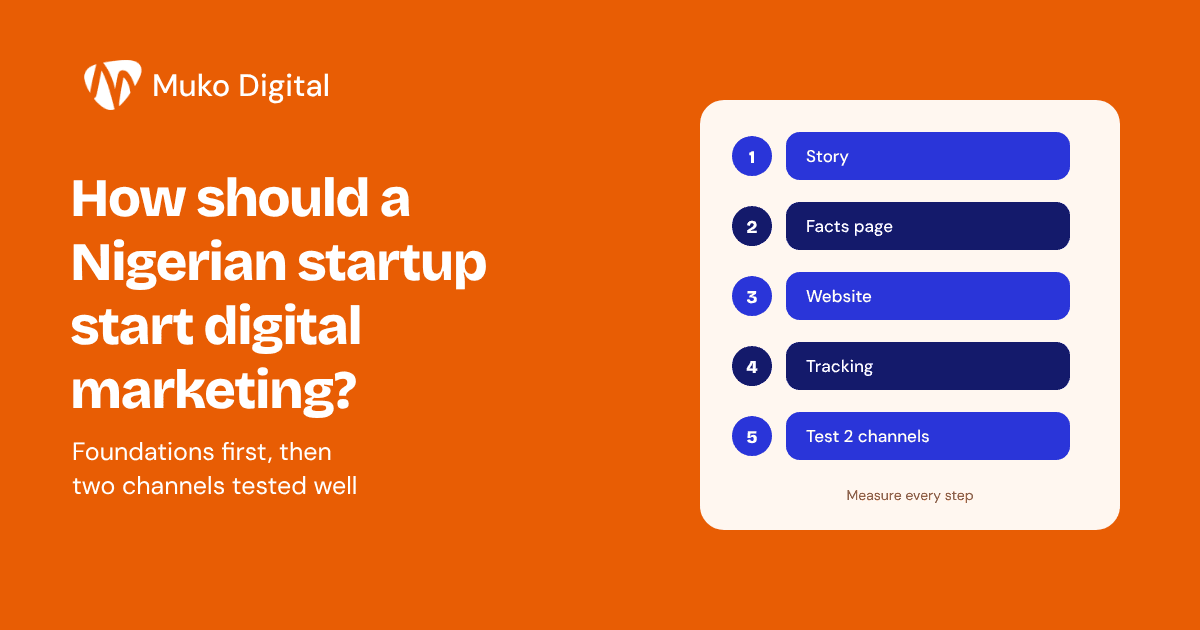
Start with the foundations: a clear one-line description, a facts page, a working website, tracking and a Google Business Profile if customers visit or call you. Then test two channels that match where your early customers already look, measure enquiries and sales for three months, and cut or scale based on the numbers. Put most of your early effort into proof and customer conversations, not paid reach.
Why Startups Need a Different Order
An established business can rely on referrals and a known name. A startup usually can't. Its customers don't know it exists, and they don't yet trust it. That makes three things more important than they are for a mature business:
- Clarity. A visitor should understand what you do within seconds.
- Proof. Credibility has to come from evidence, not from history.
- Measurement. With little money, you can't afford to guess which activity works.
Starting with reach before clarity and proof is the most common and expensive mistake we see.
The Starting Order

1. Lock in your story. Write a single sentence that says who you help, what problem you solve and how. Use it everywhere: your website, profiles, pitch and listings. Our post on brand identity in the AI era explains why consistency matters for search and AI answers.
2. Set up a facts page. Put your founding year, founders, location, product and key numbers on one dated page. Keep it current. Every directory, journalist and AI tool that describes you will draw from it, so conflicting figures cause confusion. Our Nigerian Start-up Visibility Index shows how often conflicting numbers appear across public sources.
3. Build a simple, fast website. It doesn't need to be large. It needs to explain the problem, the solution, proof, and how to get in touch or sign up. It also needs to load quickly on a phone. Our web development service covers this for startups, and our site speed guide explains what to check.
4. Set up tracking before any spend. Track sign-ups, enquiries and sales, and record where each one came from. If you can't see the source, you can't decide where to put money next.
5. Test two channels. Choose two that match where your early customers already look. Give each a clear target and three months to prove itself.

Choosing Channels to Test
Each startup's best channels depend on its customers. These are the ones most often worth testing first:
- Founder-led LinkedIn and X posts. Useful for B2B startups and for building credibility with investors, partners and journalists. Your founder's profile is often the most-cited social asset for professional queries, according to research we covered in our post on social proof for the AI era.
- WhatsApp and direct outreach. Effective for consumer startups, where early customers can be reached one by one. Track every conversation.
- Search and content. Slow to start, but valuable because answers keep working after publication. Focus on the questions your customers ask.
- Paid ads. Useful once you know what converts. Starting here with an untested offer usually spends money without learning much.
For each channel, write down the question it should answer. For example: "Do founders' posts bring demo requests?" If a channel can't answer its question within three months, pause it.
Getting Listed Where Customers and AI Tools Look
Startups gain credibility from independent sources. Our guide to getting listed in Nigerian startup directories, rankings and media covers the main options. Start with a free profile on StartupBlink, keep your Crunchbase or LinkedIn details accurate, and pitch one relevant story to a Nigerian tech publication once you have real news, such as a launch, a partnership or a measurable result.
Measuring What Matters

Choose three to five measures and review them every month:
- Enquiries or sign-ups by source, including WhatsApp and direct messages
- Conversion from visit to enquiry, to show whether the site works
- Cost per enquiry for any paid channel you test
- Customers who came from referrals or reviews
- Revenue or activation from new customers
Each measure should lead to a decision. If it doesn't change what you do next, drop it.
For a structured way to write these down, our guide to writing a digital marketing plan for a small business gives a one-page template.
What to Budget For
Startups usually underestimate three costs: the time founders spend on marketing, the cost of a website that doesn't convert, and the tools needed to track results. A small budget can still work if it covers these first. Once you know which channel brings customers, you can decide whether to bring in help.
If you're comparing outside help, our guide to digital marketing agency cost in Nigeria explains how agencies structure their fees. Its figures are US benchmarks converted to naira, not Nigerian prices. For Muko Digital's own current rates, see our pricing page.
A 90-Day Starter Plan
| Month | Focus | What to do |
| Month 1 | Foundations | Finalise your one-line story, build the facts page, fix the website's clarity and speed, set up tracking. |
| Month 2 | Test | Launch two channels, post or message consistently, and collect the first proof and reviews. |
| Month 3 | Decide | Review the numbers, keep what converts, drop what doesn't, and plan the next quarter. |
For a fuller view of what this looks like with an outside partner, read what happens in the first 90 days with a digital marketing agency.
Mistakes Startups Often Make
- Trying every channel at once
- Launching paid ads before the website explains the product
- Writing a generic story that could describe any competitor
- Ignoring tracking until the money has already gone
- Expecting viral growth from a single post
- Leaving listings, profiles and the facts page inconsistent
Where to Get Help Locally
Startups in Uyo and across Akwa Ibom can use the same principles, though local agencies and in-person networking may matter more. Our guide to digital marketing for small businesses in Uyo and Akwa Ibom covers local listings and reviews in more depth.
Conclusion
A startup's digital marketing doesn't need to be large to be effective. Get the story and the facts right, build a website that explains itself, track everything from the start, test two channels with clear questions, and decide with the numbers after three months. That order turns a small budget into learning, which is the asset a startup most needs early on.
If you'd like help setting up the foundations or testing channels, get in touch with the Muko Digital team. You can also explore our SEO, social media marketing, branding and design and PPC advertising services, or see our projects.
Frequently Asked Questions
What should a Nigerian startup do first in digital marketing?
Set a clear one-line story, build a facts page, make sure the website explains the product and loads quickly, and set up tracking before you spend anything.
How much should a startup spend on digital marketing?
There's no single figure. Start with foundations and tracking, then test one or two channels with a budget you can afford to lose while you learn. Our cost guide explains the pricing structures agencies use.
Which channel should a startup test first?
The one where your first customers already spend time. For B2B startups, that's often LinkedIn. For consumer startups, it's often WhatsApp and direct outreach.
Should a startup hire an agency or do marketing itself?
A founder can do the foundations and early testing. An agency becomes useful once you know which channels work and need more capacity or specialist skills.
How long before a startup sees results?
Early enquiries can appear within weeks, especially from direct outreach. Search and content take longer to compound, so judge them over months.