Monthly SEO Retainer vs One-Off SEO Audit: Which Should You Buy?
A new SEO client usually faces the same decision: pay for a one-off audit that shows what's wrong, or pay a monthly retainer that starts fixing it. Both are legitimate. The mistake is buying the wrong one for where the website stands, and then judging it on the wrong result.
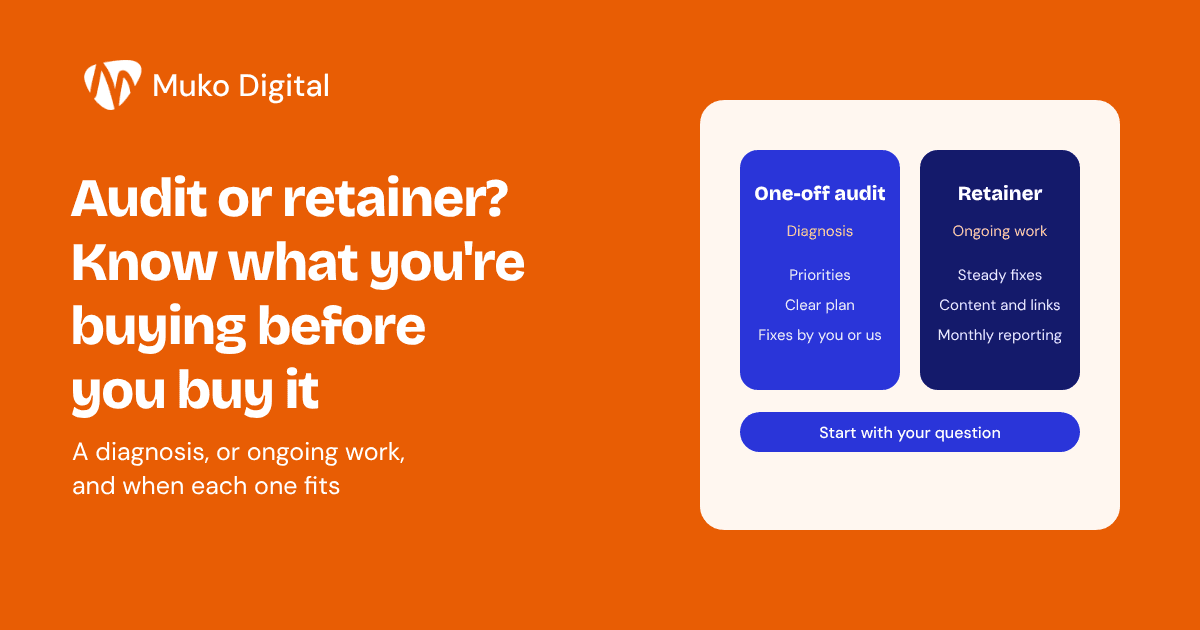
An audit is a diagnosis. A retainer is ongoing treatment. You don't always need both, and you rarely need the retainer first. This guide explains what each one includes, when each makes sense for a business of any size, and how to decide.
If you're comparing providers, our guide to how to choose the best digital marketing agency covers the selection checklist. For the wider cost picture, read our digital marketing agency cost guide.
Quick Answer
Buy a one-off SEO audit when you don't know what's broken, when a site has had a major change such as a rebuild or migration, or when you want an independent review before committing. Buy a monthly SEO retainer when you already know the problems, when search work needs ongoing content and link activity, or when your site is large enough that issues keep appearing. Many organisations start with an audit and move to a retainer once the priorities are clear.
What a One-Off SEO Audit Includes

An audit examines your site and market at a point in time and delivers a prioritised list of findings. A good audit typically covers:
- Technical health: crawlability, indexing, site speed, mobile usability, duplicate content and broken pages
- On-page structure: titles, headings, internal links and how pages map to search intent
- Content gaps: topics your competitors cover that you don't, and pages that overlap or cannibalise each other
- Off-page profile: the quality and spread of your links, and any risks
- Local and listing signals, where relevant, such as your Google Business Profile and directory consistency
- A prioritised action plan: what to fix first, what it's worth, and who should do it
The output is a document and, usually, a walkthrough call. The audit doesn't fix anything by itself. Its value is in the priorities it sets.
Our SEO service covers both audits and ongoing work.
What a Monthly SEO Retainer Includes

A retainer is ongoing work under a fixed monthly fee, usually covering:
- Technical maintenance: fixing issues as they appear, such as broken links, indexing errors or slow pages
- Content production: new or updated pages that answer the questions your audience asks, following an agreed plan
- Link and mention building: earning relevant references from other sites, rather than buying links
- Ongoing optimisation: adjusting titles, internal links and page structure based on performance
- Reporting: a regular summary of rankings, traffic and enquiries, tied to the goals you agreed
The key word is ongoing. SEO results build over months, and the work has to keep going. A retainer without a clear scope, reporting and a named lead is just a monthly invoice.
Comparing the Costs
Nigerian SEO rates aren't published in a consistent way, so the clearest reference point is the US benchmark. DesignRush's 2026 SEO pricing guide reports monthly SEO retainers of $500 to $7,500 and standalone technical audits of $2,500 to $15,000. Converted at an assumed ₦1,350 to $1, that's roughly ₦675,000 to ₦10.1 million a month for the retainer, and ₦3.4 million to ₦20.3 million for the audit.
These are US figures for SEO only. They don't include tool subscriptions, developer time for fixes or ad spend, and US agencies generally charge more than those serving Nigerian businesses. Use them to understand how the two options are structured, not as a quote. Our cost guide explains the wider pricing models, and for Muko Digital's own current rates, see our pricing page.
The more useful comparison is this: an audit is a one-time cost that shapes the work, while a retainer is a recurring cost that carries it out. A low-cost audit that's never implemented is more expensive than a retainer that fixes the top three issues.
When an Audit Comes First
An audit is usually the right first step when:
- You don't know what's broken. Traffic has dropped, rankings are unclear, or a previous provider's work is unexplained.
- The site has changed significantly. A redesign, migration, domain change or platform switch can break search visibility, and an audit should check it before and after.
- You're evaluating providers. An audit from an independent team is a fair way to test their thinking and their reporting before you sign a retainer.
- You have an in-house team that can implement. If your developers and writers can do the work, an audit gives them the plan.
- The site is large or complex. Enterprise sites with many markets, languages or product lines often need a full audit to map the work before any retainer is sized.
When a Retainer Makes Sense
A retainer usually fits when:
- The priorities are already known and need steady execution, not diagnosis
- Content and links are the bottleneck, because those take continuous effort over months
- The site keeps producing issues, such as frequent new pages, product launches or multiple contributors
- You want one accountable team rather than separate specialists for each task
- You're growing into new markets or regions and need ongoing coordination
The Hybrid Route
Many clients buy an audit, then choose which parts of its plan to keep in-house and which to hand to a retainer. This is often the most efficient route. It keeps the diagnosis independent, and it means you only pay ongoing fees for work that genuinely needs continuity.
The risk is that an audit becomes a shelf document. To avoid that, agree in advance who will implement the top priorities, and set a review date at 30 and 90 days.

How to Decide
Answer three questions:
- Do we know what needs fixing? If not, start with an audit.
- Do we have the people to implement the fixes? If not, a retainer or hybrid route will be needed.
- Does the work need to continue month after month? If so, a retainer is the right model.
If your answer to question 1 is no and question 3 is yes, an audit followed by a retainer is usually the strongest route.
What to Ask Before You Buy
Put these questions to any provider, whether you're buying an audit or a retainer:
- What exactly will I receive, and in what format?
- Who will do the work, and how much of their time is included?
- How will you report progress, and how often?
- How do you measure SEO results, and over what period?
- What is excluded, including tools, development and content writing?
- What is the notice period if I end the work?
- Who owns the reports, the accounts and any content produced?
Also ask how they avoid unnatural or purchased links. Any provider that guarantees rankings or promises a quick result is a warning sign, because search outcomes depend on competitors, algorithm changes and the quality of the site itself.
What SEO Can and Can't Promise
No provider can guarantee a position on Google. What they can control is the quality of the work: sound technical foundations, relevant content, useful pages and a credible profile. Good SEO work tends to show results over months, and the timing varies by site, market and competition.
Expect an audit to deliver a clear plan within weeks, and a retainer to show measurable movement over a few months, with compounding effects after that.
Conclusion
A one-off audit tells you what to fix. A monthly retainer keeps the work moving. Buy an audit when the problems are unclear, or the site has changed, and a retainer when the priorities are known and the work needs to continue. For many organisations, the audit comes first and shapes the retainer that follows.
If you'd like an independent view of where your site stands, get in touch with the Muko Digital team. You can also explore our SEO service, web development and content marketing services, or see our projects.
Frequently Asked Questions
Is an SEO audit worth it?
Usually, if you don't know what's holding your site back or it has recently changed. The value depends on whether the findings are implemented, so agree who will do the work before you buy.
Is a monthly SEO retainer better than an audit?
They do different jobs. A retainer carries out ongoing work, while an audit sets the priorities. Many organisations do an audit first and then decide whether a retainer is needed.
How much does an SEO audit cost?
Nigerian audit prices aren't published consistently. US benchmarks reported by DesignRush range from $2,500 to $15,000, which is a US figure, not a Nigerian quote.
How long does an SEO retainer take to show results?
Expect early technical improvements within weeks. Content and link-driven gains usually take a few months to build, and the timing varies by site and competition.
Can I do an SEO audit myself?
Basic checks are possible with free tools. A full audit needs technical depth and time, which is why most businesses buy one from a specialist.