SEO vs Paid Advertising: Which Is Better for Business Growth?
Every growing business faces this choice sooner or later. Paid advertising promises customers this week. SEO promises customers for years if you're willing to wait for them. Both are real channels, and both can grow a business. The question is which one should carry the weight and when.
This guide compares the two on speed, durability, cost behaviour and control. It also shows how the best-run programmes use each to strengthen the other. Whether you're a young company or an established enterprise, the trade-offs are the same. Only the scale changes.
If you're deciding how to structure your budget, our guide to how to choose the best digital marketing agency covers the selection side, and our digital marketing agency cost guide explains how the work is priced.
Quick Answer
Paid advertising is better for speed, for testing a new offer and for a time-limited push. SEO is better for lasting traffic and lower dependence on any single platform. For most growing businesses, the answer isn't either/or. Use paid ads to find out which messages and queries convert, then build SEO pages around them so the traffic keeps coming after the spend stops.
How the Two Compare

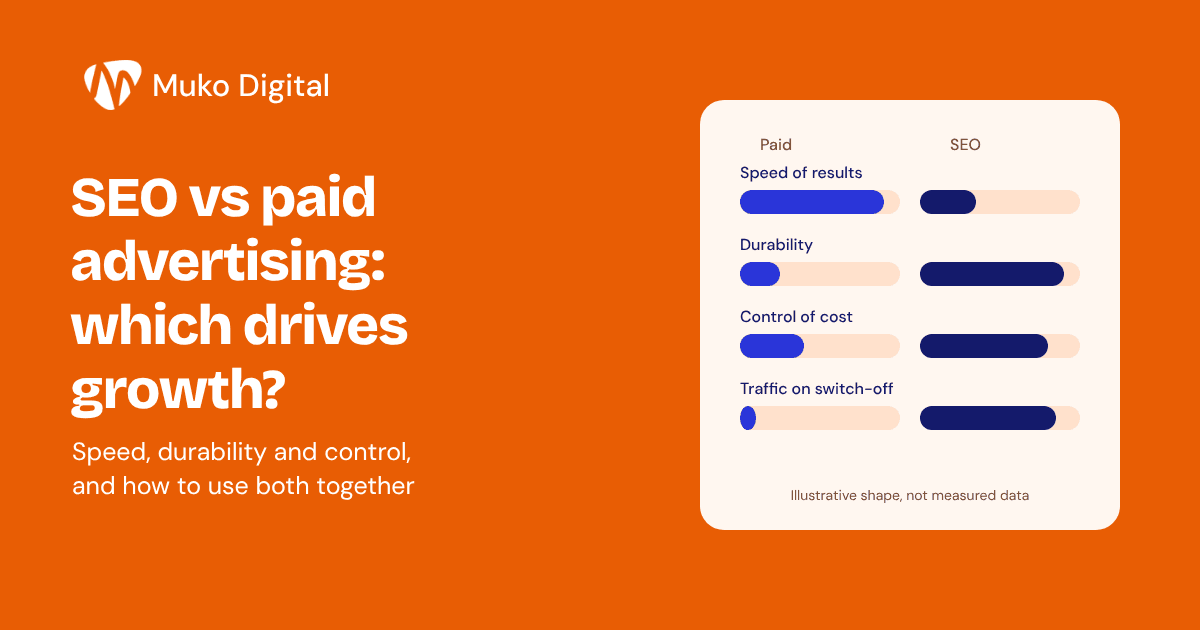
Speed. Paid campaigns can produce clicks and enquiries within days of launch. SEO usually takes months to show meaningful gains, because search engines need to find, index and rank your pages, and they need time to judge them.
Durability. When you stop paying for ads, traffic from them stops too. SEO traffic tends to persist. Pages that rank well can keep bringing visitors long after the work that produced them is finished, though they need upkeep as competitors and search behaviour change.
Cost behaviour. Paid costs rise with volume: to get more clicks, you usually pay more per click, and competition in your category can push that up. SEO is front-loaded, since most of the cost is in research, content and technical work, and the ongoing cost is steadier.
Control. Paid results depend on ad platforms, their auctions and their policies, which can change without much notice. SEO depends on your site and content, which you control, though search engines also change how they rank.
Measurement. Paid is easy to measure in the short term through clicks, cost per click and cost per enquiry. SEO is measured through rankings, organic visits and the enquiries those visits create. Both should be judged on enquiries and revenue, not on clicks alone.
Treat these as general patterns. The timing and costs depend on your market, your competition and the quality of your site.
Where Paid Advertising Wins
Paid advertising is usually the right tool when:
- You need enquiries now, for a launch, a seasonal push or a time-limited offer
- Your offer is new and untested, so you want fast feedback on which message works
- You can measure cost per enquiry, and the numbers make sense against your margins
- You're entering a market where organic results are slow to build, and you need visibility while your content grows
The discipline matters. Paid works best when the landing page is clear, tracking is in place, and you know what a good enquiry is worth to you. Without those, paid spend tends to bring traffic without sales.
Where SEO Wins
SEO is usually the stronger investment when:
- You want traffic that lasts and that doesn't depend on continuing to pay for each visit
- Customers search for your category in the terms they use to solve a problem
- You have content or pages to build, and the team to keep them accurate
- You can wait several months for the work to compound
SEO also builds the proof that AI search tools look for. Our guide on social proof for AI explains how third-party signals feed AI answers, which is worth keeping in mind when you plan content.

Use Paid to Learn, SEO to Keep
The most effective programmes treat the two as partners.

- Test with paid. Run small campaigns on a few offers and messages to find out which ones attract enquiries.
- Learn the language. Note the queries and wording that convert, since those reflect how real customers describe their problem.
- Build SEO pages. Create pages that answer those questions on your own site, using the language that worked.
- Reduce dependence. As those pages rank, shift traffic from paid to organic and reduce spend on the terms you've already won.
The loop also runs the other way. SEO data shows which topics attract visitors, and those topics can guide which paid campaigns are worth testing. Together, the two channels make each other cheaper to run over time.
What to Measure for Each Channel

Judge each channel on what it's responsible for:
- Paid: cost per enquiry, conversion rate from click to enquiry, and click-through rate on each ad
- SEO: rankings for your target queries, organic visits, and the enquiries those visits create
- Both: enquiries by source and revenue from new customers, so you can see which channel brought them
If you only measure clicks, paid will look busy and SEO will look slow. Measuring enquiries and revenue gives a fairer picture of both.
Common Mistakes
- Choosing a channel because it's easy to start. Paid is quick to launch, but quick launches can drain budget without teaching you anything.
- Expecting SEO to deliver in weeks. It compounds, but it doesn't switch on overnight.
- Sending paid traffic to weak pages. Traffic to an unclear page converts poorly, whichever channel it came from.
- Stopping SEO work once rankings improve. Competitors keep working, so pages need updating.
- Comparing channels on clicks. Judge both on enquiries and revenue.
How to Start
If you're starting from nothing, begin with the basics: a clear site, working tracking and a short list of the questions your customers ask. Run one or two paid tests to find the messages that convert, and begin building SEO pages around the questions that show demand. Review the numbers every month and shift the budget as the evidence changes.
For a structured way to plan this, our guide to what happens in the first 90 days with a digital marketing agency explains the early phases, and our AI visibility audit guide shows how to check whether customers can find you in AI answers as well as search.
Conclusion
SEO vs paid advertising isn't really a contest. Paid advertising gives you speed and fast feedback. SEO gives you durable traffic and lower dependence on any single platform. The strongest growth comes from using paid to learn what works and SEO to keep it working.
If you'd like help deciding how to split your budget between the two, get in touch with the Muko Digital team. You can also see our SEO service and PPC advertising service, or browse our projects.
Frequently Asked Questions
Is SEO better than paid advertising?
Neither is better in every case. SEO builds traffic that lasts, while paid advertising delivers quicker results. Most growing businesses benefit from using both.
How long does SEO take to show results?
It usually takes months to show meaningful gains, because search engines need time to find, index and rank pages. The results then tend to persist.
Does paid advertising help SEO?
Indirectly. Paid tests show which messages and queries convert, and that information can guide the pages you build for search.
Should I stop paid ads once SEO starts working?
Not necessarily. Many businesses keep a smaller paid budget for launches, seasonal offers and high-intent terms they haven't won organically.
How do I know which channel is working?
Measure enquiries and revenue by source. Clicks alone can make paid look better than it is and make SEO look worse.